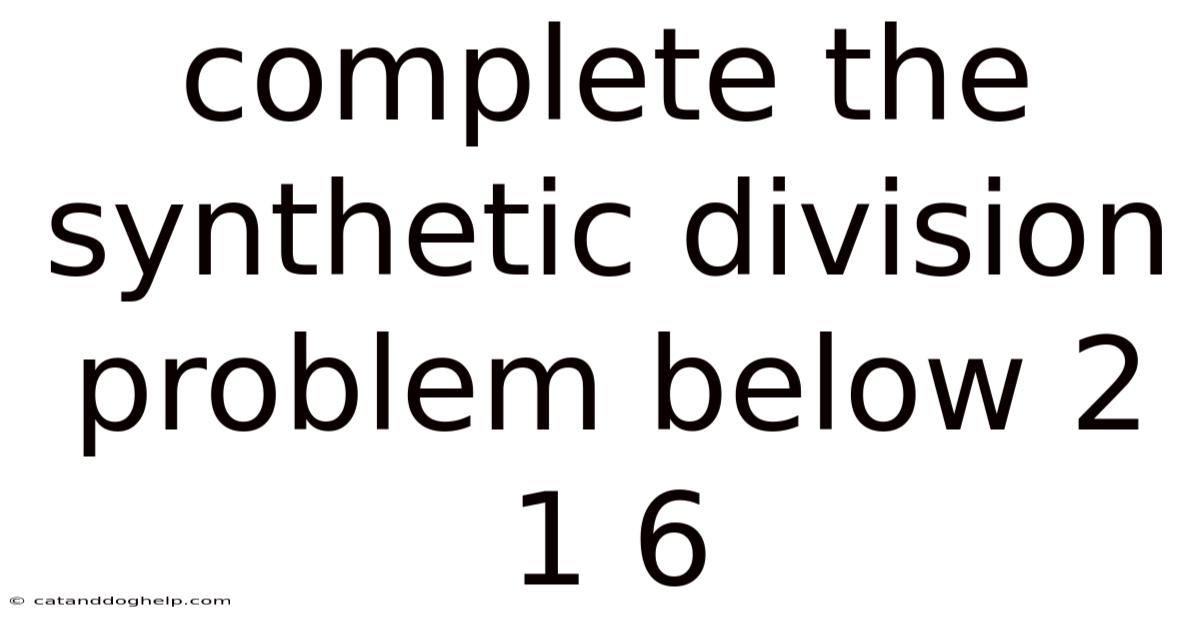
Imagine you are a math student, sitting in class, staring at a seemingly complex division problem. But traditional long division feels tedious and time-consuming. Then, your teacher introduces you to a streamlined method: synthetic division. Suddenly, the problem transforms into an approachable, almost puzzle-like exercise. This efficient technique unlocks a faster way to divide polynomials, especially when dividing by a linear factor.
Think about how many times you've encountered division in everyday life, from splitting a restaurant bill to calculating proportions in a recipe. Now, extend that concept to the world of polynomials. Synthetic division isn't just a mathematical trick; it's a powerful tool that simplifies polynomial division, making it easier to find factors and solve equations. Let's dive into the intricacies of completing a synthetic division problem, using the example "2 | 1 6" as our starting point.
Main Subheading: Understanding Synthetic Division
Synthetic division is a shorthand method of dividing a polynomial by a linear factor of the form x - a. Think about it: it provides a more efficient way to find the quotient and remainder compared to long division, especially when dealing with higher-degree polynomials. The process involves using only the coefficients of the polynomial and the root of the linear factor The details matter here..
At its core, synthetic division relies on systematically manipulating the coefficients of the polynomial to determine the resulting quotient and remainder. It's a technique that hinges on understanding place value and the relationships between polynomial terms. While it might seem abstract at first, mastering synthetic division can significantly speed up your problem-solving abilities in algebra and calculus.
Comprehensive Overview
Definition and Purpose
Synthetic division is a simplified algorithm for dividing a polynomial by a linear divisor. Its primary purpose is to determine the quotient and remainder resulting from this division. Unlike long division, which involves writing out the entire division process, synthetic division focuses only on the coefficients, making it faster and more compact.
And yeah — that's actually more nuanced than it sounds.
Scientific Foundations
The scientific foundation of synthetic division lies in the polynomial remainder theorem and the factor theorem. The polynomial remainder theorem states that if a polynomial f(x) is divided by x - a, then the remainder is f(a). The factor theorem is a direct consequence of the remainder theorem, stating that x - a is a factor of f(x) if and only if f(a) = 0 Easy to understand, harder to ignore..
Historical Context
Synthetic division has evolved over centuries, with mathematicians continually seeking efficient methods for polynomial division. While its exact origins are difficult to pinpoint, similar techniques have been used in various forms throughout mathematical history. The modern form of synthetic division is a result of efforts to streamline algebraic manipulations and simplify complex calculations Worth keeping that in mind..
The Process Explained
The basic setup for synthetic division involves writing the root of the linear divisor on the left and the coefficients of the polynomial on the right. Then, a series of additions and multiplications are performed to obtain the coefficients of the quotient and the remainder. Let's break down the steps in detail:
- Write the divisor: Identify the root a from the linear divisor x - a and write it down.
- Write the coefficients: Write down the coefficients of the polynomial in descending order of degree. Make sure to include zeros as placeholders for any missing terms.
- Bring down the first coefficient: Bring down the first coefficient of the polynomial to the bottom row.
- Multiply and add: Multiply the root a by the number in the bottom row, and write the result under the next coefficient. Add the numbers in that column and write the sum in the bottom row.
- Repeat: Repeat the multiply and add steps until you have processed all coefficients.
- Interpret the results: The last number in the bottom row is the remainder. The other numbers in the bottom row are the coefficients of the quotient polynomial, with the degree one less than the original polynomial.
Applying Synthetic Division to "2 | 1 6"
Now, let's apply synthetic division to the example "2 | 1 6". This notation implies we are dividing a polynomial by x - 2. On the flip side, the "1 6" likely represents the coefficients of a polynomial. For synthetic division to work properly, we need to interpret "1 6" as representing the polynomial 1x + 6 (or simply x + 6).
Here's how we perform the synthetic division:
-
Write the divisor: The root of the divisor x - 2 is 2. So, we write 2 on the left Not complicated — just consistent..
-
Write the coefficients: The coefficients of the polynomial x + 6 are 1 and 6.
-
Set up the synthetic division:
2 | 1 6 | |__________ -
Bring down the first coefficient: Bring down the 1 to the bottom row Worth keeping that in mind..
2 | 1 6 | |__________ 1 -
Multiply and add: Multiply 2 by 1, which gives 2. Write 2 under the 6. Add 6 and 2, which gives 8.
2 | 1 6 | 2 |__________ 1 8 -
Plus, Interpret the results: The numbers in the bottom row are 1 and 8. This means the quotient is 1 (which represents 1x⁰ or just 1) and the remainder is 8.
You'll probably want to bookmark this section.
Because of this, when we divide x + 6 by x - 2, the quotient is 1 and the remainder is 8. We can express this as:
(x + 6) / (x - 2) = 1 + 8/(x - 2)
Handling Missing Terms
One crucial aspect of synthetic division is handling missing terms in the polynomial. If a polynomial has a missing term (e.g., x³ + 2x + 1 is missing an x² term), you must include a zero as a placeholder for that term. Failing to do so will lead to incorrect results.
As an example, if we wanted to divide x³ + 2x + 1 by x - 1, we would write the coefficients as 1, 0, 2, and 1. The synthetic division would look like this:
1 | 1   0   2   1
  |     1   1   3
  |________________
    1   1   3   4
The quotient is x² + x + 3, and the remainder is 4.
Advantages and Limitations
Synthetic division offers several advantages over long division:
- Efficiency: It's faster and more compact, especially for higher-degree polynomials.
- Simplicity: It only involves addition and multiplication, making it easier to perform.
- Focus on coefficients: It eliminates the need to write out the variables, reducing the chance of errors.
Even so, synthetic division also has limitations:
- Linear divisors only: It can only be used when dividing by a linear factor of the form x - a.
- Polynomial must be in standard form: The polynomial must be written in standard form (descending order of degree).
- Missing terms require placeholders: Missing terms must be accounted for with zero placeholders.
Trends and Latest Developments
While the core principles of synthetic division remain unchanged, its application has evolved with advancements in computing and mathematical software. Modern calculators and computer algebra systems (CAS) can perform synthetic division instantly, allowing students and researchers to focus on higher-level problem-solving.
Beyond that, synthetic division has found applications in fields beyond traditional algebra. Consider this: it is used in coding theory for error detection and correction, and in numerical analysis for approximating roots of polynomials. The ongoing development of algorithms and software continues to expand the reach and utility of synthetic division.
Tips and Expert Advice
Verify Your Results
After performing synthetic division, always verify your results by multiplying the quotient by the divisor and adding the remainder. Consider this: this should give you the original polynomial. This step helps catch any errors made during the process Surprisingly effective..
For our example, we found that (x + 6) / (x - 2) = 1 + 8/(x - 2). To verify, we can multiply the quotient (1) by the divisor (x - 2) and add the remainder (8):
1 * (x - 2) + 8 = x - 2 + 8 = x + 6
This confirms that our synthetic division was performed correctly.
Practice Regularly
Like any mathematical technique, mastering synthetic division requires practice. Work through a variety of examples, including those with missing terms and different divisors. The more you practice, the more comfortable you will become with the process.
Understand the Underlying Theory
While it's possible to perform synthetic division mechanically, understanding the underlying theory can help you apply it more effectively. Familiarize yourself with the polynomial remainder theorem and the factor theorem. This will give you a deeper understanding of why synthetic division works and how it relates to other concepts in algebra Simple, but easy to overlook..
Use Technology Wisely
While calculators and CAS can perform synthetic division for you, make sure to understand how to do it by hand. Relying solely on technology can hinder your understanding of the process. Use technology as a tool to check your work, but always make sure you can perform synthetic division manually That alone is useful..
Break Down Complex Problems
If you encounter a complex polynomial division problem, break it down into smaller, more manageable steps. This can make the problem less daunting and reduce the chance of errors. To give you an idea, you might first simplify the polynomial or factor out common terms before applying synthetic division Small thing, real impact..
Pay Attention to Signs
One common source of errors in synthetic division is incorrect signs. Here's the thing — be especially careful when multiplying and adding negative numbers. Double-check your work to check that you have the correct signs for all terms.
Use Color-Coding
When performing synthetic division by hand, use different colors to highlight the different steps. Day to day, this can help you keep track of your work and reduce the chance of making mistakes. Here's one way to look at it: you might use one color for the coefficients of the polynomial, another color for the root of the divisor, and a third color for the numbers in the bottom row.
FAQ
Q: Can synthetic division be used for divisors other than linear factors?
A: No, synthetic division is specifically designed for dividing by linear factors of the form x - a. For divisors of higher degree, you must use long division.
Q: What happens if the polynomial has missing terms?
A: If the polynomial has missing terms, you must include zeros as placeholders for those terms. Failing to do so will result in incorrect results.
Q: How do I interpret the results of synthetic division?
A: The last number in the bottom row is the remainder. The other numbers in the bottom row are the coefficients of the quotient polynomial, with the degree one less than the original polynomial The details matter here..
Q: Is synthetic division always faster than long division?
A: Yes, synthetic division is generally faster than long division, especially for higher-degree polynomials. Even so, it can only be used for linear divisors.
Q: What is the relationship between synthetic division and the factor theorem?
A: The factor theorem states that x - a is a factor of f(x) if and only if f(a) = 0. In synthetic division, if the remainder is 0, then x - a is a factor of the polynomial.
Conclusion
Synthetic division is a powerful and efficient method for dividing polynomials by linear factors. From our example of "2 | 1 6," which we interpreted as dividing x + 6 by x - 2, we found the quotient and remainder using this streamlined approach. Worth adding: by understanding the underlying principles and practicing regularly, you can master this technique and apply it to solve a variety of algebraic problems. Plus, remember to always verify your results and pay attention to signs to avoid errors. So, continue exploring the world of polynomials, and let synthetic division be your trusted tool in simplifying complex divisions Not complicated — just consistent..
Ready to put your synthetic division skills to the test? Try working through some practice problems or exploring more advanced applications of this technique. Share your experiences and questions in the comments below, and let's continue learning together!
